

The law treats AI (and many digital technologies) with a special exceptionalism. AI evades rules that apply to nearly everything else.
For example, recent news stories discussed incidents where AI “escaped” and “acted on its own” to commit cyberattacks. I saw the initial reaction all across the media, where the sentiment was: Wow, AI is becoming so dangerous and powerful! AI could become autonomous and escape our control.
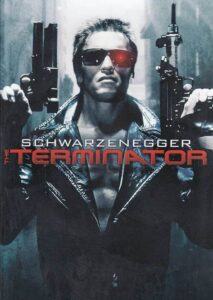
This response evokes the movie, The Terminator (1984), where AI tries to wipe out humanity.
But there’s another reaction I have, one where I ask incredulously: How should this even be allowed to happen? Should companies be permitted to develop and play around with such dangerous technologies with hardly any controls? Where’s the accountability if something goes wrong?
The Anthropic IPO filing states:
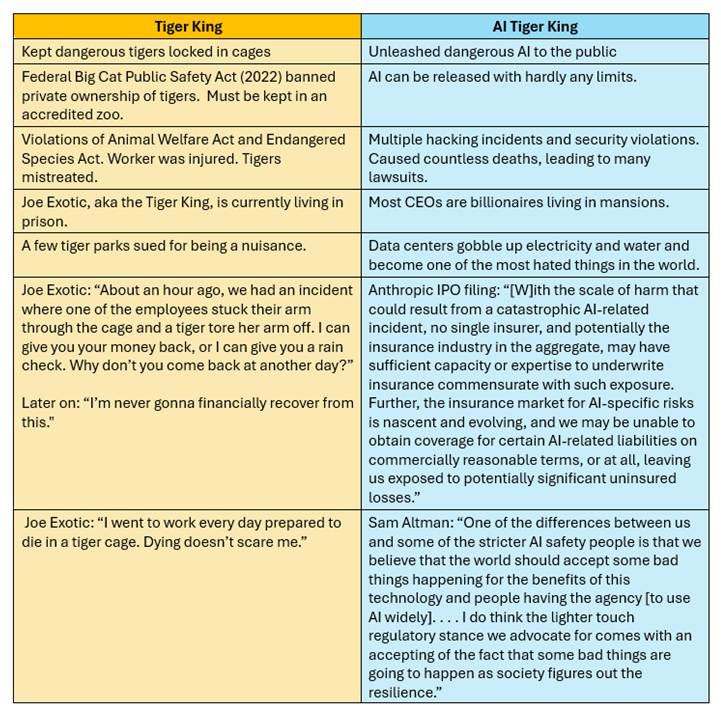
[W]ith the scale of harm that could result from a catastrophic AI-related incident, no single insurer, and potentially the insurance industry in the aggregate, may have sufficient capacity or expertise to underwrite insurance commensurate with such exposure. Further, the insurance market for AI-specific risks is nascent and evolving, and we may be unable to obtain coverage for certain AI-related liabilities on commercially reasonable terms, or at all, leaving us exposed to potentially significant uninsured losses.
A statement like this strikes me as utterly outrageous. I ask: In what kind of bizarro world would the law would allow a company to plow ahead and develop something like this, relying on the company to implement its own guardrails?
Imagine if this weren’t AI or some form of digital technology. The law would be reacting quite differently.
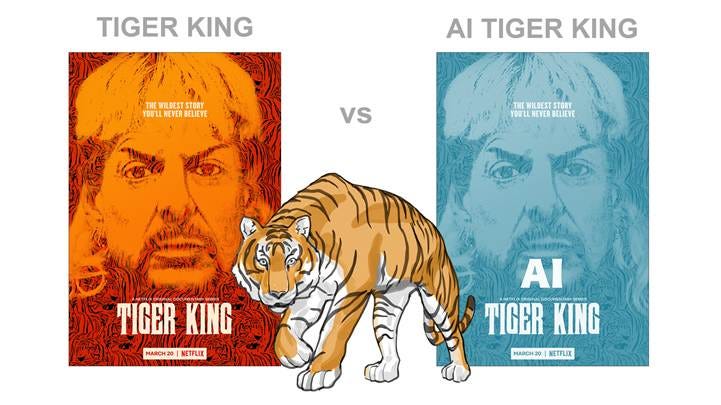
Instead of The Terminator, perhaps a better analogy is the classic Netflix show, Tiger King (2020). The show depicted the crazy world of privately owned tiger parks. When I watched the show, I wondered how these parks could operate in broad daylight. Regulation was too loose, but there actually was some regulation. And within a few years, Congress passed the Big Cat Public Safety Act to ban private ownership of tigers, unless they are kept in an accredited zoo (but there’s a grandfather clause . . . sigh).
But one thing was clear with Tiger King: We never lost sight of the fact that it is the park owners like Joe Exotic who are responsible. If a tiger escapes and mauls a person, its keeper is strictly liable. We wouldn’t blame the tiger. We’d immediately point the finger at the tiger’s keeper and be outraged that any random guy could keep tigers for entertainment and profit.
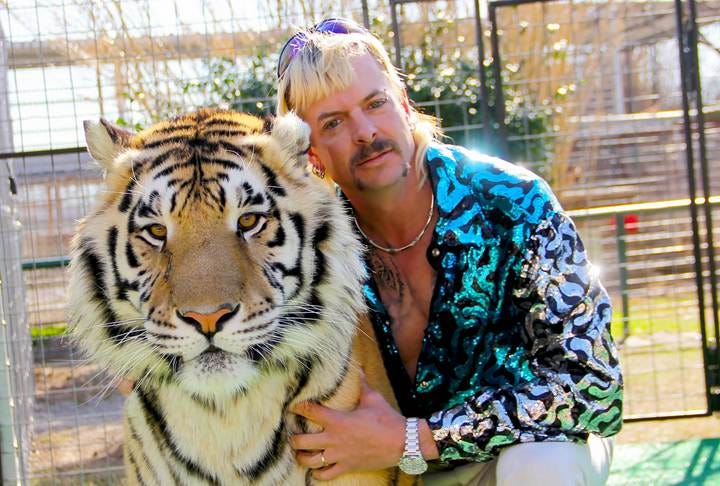
In many ways, the law deals with tigers more sanely than it does with AI. AI models are often unleashed to the world, despite grave risks and even instances where they cause major damage, such as hacking and even deaths. At least the tigers are kept in cages. AI is often just let loose upon the world and handed over to anyone, anywhere, for nearly any purpose they can dream of.
Comparing the Tiger King to an equivalent AI Tiger King illustrates the absurdity of the way the law currently treats AI. Here’s a little chart I made:
We live in an absurd world. Here are a few thoughtful pieces about how the law should sanely respond to AI safety issues rather than the ridiculous way the law is currently responding:
- Nita Farahany, More Cyberattacks Are Coming: Are We Ready?
- Luiza Jarovsky, How to Address the AI Safety Crisis
* * * *
Daniel J. Solove is the Bernard Professor of Intellectual Property and Technology Law at the George Washington University Law School. He is the founder of TeachPrivacy, a company that provides workforce privacy, cybersecurity security, and AI training to companies and organizations around the world. He is the author of 10+ books and 100+ articles.
You can follow his events, writings, training, cartoons, and resources by subscribing to his free weekly newsletter.

Subscribe to Solove’s Free Substack
A supplement to Solove’s regular newsletter with more in-depth discussions