


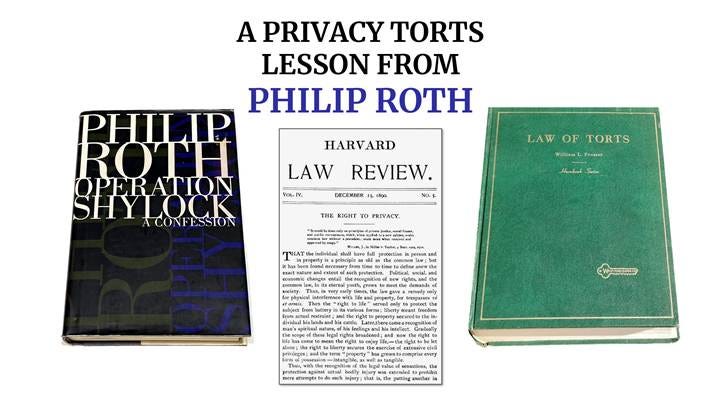
With its central theme of appropriating identity, Philip Roth’s novel Operation Shylock: A Confession (1993) involves a fictional account of himself meeting a man impersonating him. Roth decides to impersonate his impersonator.
In one passage in the book, Roth provides a mini law lesson on the Warren and Brandeis privacy torts as defined by William Prosser:
“Why,” he asked, would I want to do a thing like that?”
“Because you’re involved in a deceptive practice. Because you’re breaking the law.”
“Which law? Israeli law, Connecticut state law, or international law?”
“The law that says that a person’s identity is his private property and can’t be appropriated by somebody else.”
“Ah, so you’ve been studying your Prosser.”
“Prosser?”
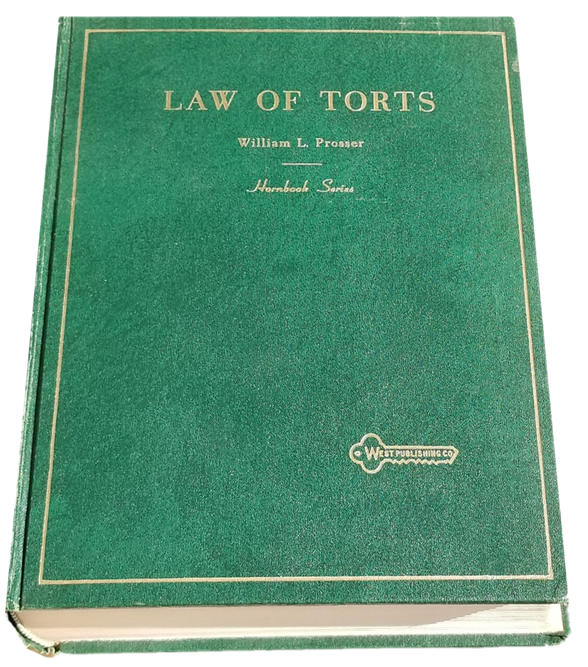
“Professor Prosser’s Handbook on the Law of Torts.”
“I haven’t been studying anything. All I need to know about a case like this common sense can tell me.”
“Well, still, take a look at Prosser. In 1960, in the California Law Review, Prosser published a long article, a reconsideration of the original 1890 Warren and Brandeis Harvard Law Review article in which they’d borrowed Judge Cooley’s phrase ‘the general right to be let alone’ and staked out the dimensions of the privacy interest. Prosser discusses privacy cases as having four separate branches and causes of action—one intrusion upon seclusion; two, public disclosure of private facts; three, false light in the public eye; and four, appropriation of identity. The prima facie case is defined as follows: ‘One who appropriates to his own use or benefit the name or likeness of another is subject to liability to the other for invasion of his privacy.’ Let’s have lunch.”
(pp. 75-76)
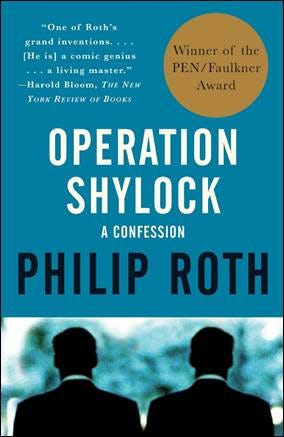
Roth began the lesson, but then he quickly stopped for lunch. I thought I’d chip in with some additional thoughts. The article that launched the privacy torts was Samuel D. Warren & Louis D. Brandeis, The Right to Privacy, 4 Harvard Law Review 193 (1890).
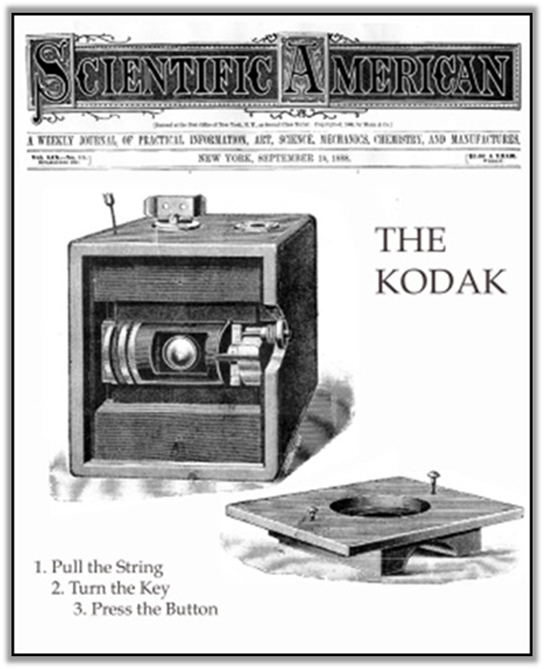
Warren and Brandeis discussed how journalism was becoming more sensationalistic: “Gossip is no longer the resource of the idle and of the vicious, but has become a trade, which is pursued with industry as well as effrontery.” And they expressed concern about a new technology they called “instantaneous photograph[y.]” — the new smaller and cheaper cameras being marketed by the Eastman Kodak Company that made it possible for candid photos to be taken.
Warren and Brandeis called for a tort remedy for privacy violations. They argued that although the law currently didn’t recognize tort protections for privacy violations, there was a basis in the law to remedy privacy harms through tort actions.
Although the privacy article inspired a handful of law review articles in response, there was little activity in courts or legislatures. The article appeared to be a flop. The law was unchanged, and the authors didn’t write anything more on privacy.
Then, in 1902, in Roberson v. Rochester Folding Box Company, 64 N.E. 442 (N.Y. 1902), a woman used Warren and Brandeis’s article to claim she could sue when a company used her image on an advertisement without her consent. The court held that the right to privacy had no basis in the law.
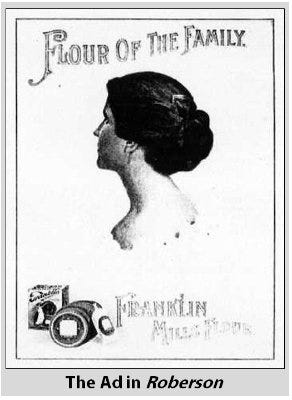
But the court’s decision wasn’t the end of the matter. The case sparked public attention, and the court’s decision was vigorously criticized by the media and other commentators. A year later, in 1903, the New York legislature enacted a statute to allow people to sue for invasion of privacy. Warren and Brandeis finally had their first victory.
So it took 13 years before finally the law changed in response to the article — and it was only one state’s law.
In 1905, the Georgia Supreme Court recognized in the common law a tort remedy for invasions of privacy. Pavesich v. New England Life Insurance Company, 50 S.E. 68 (Ga. 1905).
So 15 years later, and two states now had a right to privacy. But the impact of the article was still not enough to warrant more than a footnote in the history of privacy law.
By 1940, 50 years after the article, 15 states recognized a right to privacy. A decent showing, but still not a huge impact . . . maybe worth a sentence or two in the history of privacy law.
But then along came William Prosser, the most famous torts scholar of his day, perhaps of all time. He wrote an article in 1960 which Roth references: William L. Prosser, Privacy, 48 Cal. L. Rev. 383 (1960). This article discussed and categorized all the cases involving torts inspired by the Warren and Brandeis article.
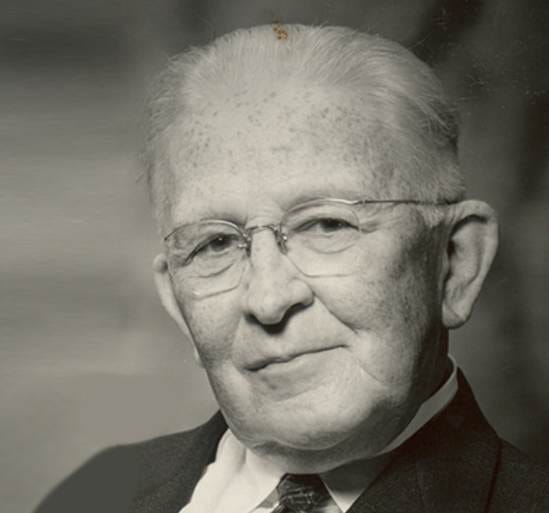
Prosser also included the Warren and Brandeis privacy torts in his treatise on torts. When the leading torts expert focused so much attention on these torts, lawyers and judges paid more attention. More states started to recognize them.
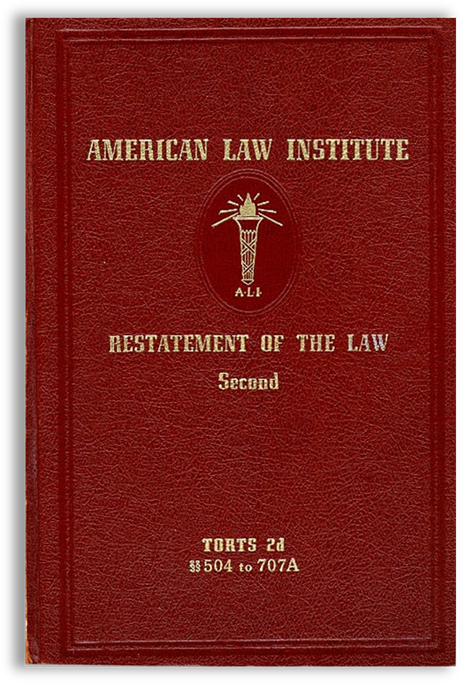
Today, the vast majority of states — more than 90% — recognize one or more torts based on Warren and Brandeis’s article. There are four different widely-recognized torts to protect privacy that have been created based on the Warren and Brandeis article (I’m including the Restatement definitions):
Intrusion Upon Seclusion: One who intentionally intrudes, physically or otherwise, upon the solitude or seclusion of another or his private affairs or concerns, is subject to liability to the other for invasion of his privacy, if the intrusion would be highly offensive to a reasonable person.
Public Disclosure of Private Facts: One who gives publicity to a matter concerning the private life of another is subject to liability to the other for invasion of his privacy, if the matter publicized is of a kind that (a) would be highly offensive to a reasonable person, and (b) is not of legitimate concern to the public.
False Light: One who gives publicity to a matter concerning another that places the other before the public in a false light is subject to liability to the other for invasion of his privacy, if (a) the false light in which the other was placed would be highly offensive to a reasonable person, and (b) the actor had knowledge of or acted in reckless disregard as to the falsity of the publicized matter and the false light in which the other would be placed.
Appropriation of Name or Likeness: One who appropriates to his own use or benefit the name or likeness of another is subject to liability to the other for invasion of his privacy.
The tort Roth references is appropriation of name or likeness. This was the tort involved in Roberson and Pavesich, the first tort that emerged after Warren and Brandeis’s article.
Prosser had a big impact in establishing the privacy torts, but he also ironically limited the torts. Warren and Brandeis urged courts to generate a variety of new torts to address privacy violations as technology evolved. Courts started to do this, but after Prosser wrote his 1960 article, courts settled on Prosser’s four types and didn’t continue to create new torts. The privacy torts ossified, their elements becoming frozen and rigid.
Today, the Warren and Brandeis privacy torts are struggling to address the challenges posed by modern digital technologies. Were they to rise from the grave, Warren and Brandeis would surely complain that courts and legislatures shouldn’t have stopped innovating with the privacy torts after 1960 and would urge the creation of new torts to deal with today’s problems.
If you’re interested in this part of the history of privacy torts, see my article, Prosser’s Privacy Law: A Mixed Legacy, 98 California Law Review 1887 (2010) (with Neil M. Richards).
It’s not every day that there’s a law lecture in fiction, especially one on privacy law, so discovering it in Philip Roth’s Operation Shylock: A Confession was quite a moment for a privacy law nerd.
* * * *
Daniel J. Solove is the Bernard Professor of Intellectual Property and Technology Law at the George Washington University Law School. He is the founder of TeachPrivacy, a company that provides workforce privacy, cybersecurity security, and AI training to companies and organizations around the world. He is the author of 10+ books and 100+ articles.
You can follow his events, writings, training, cartoons, and resources by subscribing to his free weekly newsletter.

Subscribe to Solove’s Free Substack
A supplement to Solove’s regular newsletter with more in-depth discussions