



I’ve curated a list of recent works on privacy, AI, and tech that will be worth your time checking out. For earlier editions of Works Worth Your Attention, see here.
Fourth Amendment
Andrew Guthrie Ferguson, Digital Policing after Chatrie, Ohio St. J. Crim. L. (forthcoming 2026)
Abstract:
Chatrie v. United States is a consequential Fourth Amendment opinion, and for Supreme Court watchers a surprising one in its scope and implications. Chatrie was a test about which vision of the Fourth Amendment would prevail. Would the Court build on the privacy protective principles developed in Carpenter v. United States and interpret the Fourth Amendment to respond to growing technological threats of police surveillance or relegate Carpenter to a narrow decision without continued support within an arguably more conservative Court?
In Chatrie, Supreme Court chose to expand Fourth Amendment protections to meet the challenges of the digital age. Not only did the Court confirm that digital is different when it comes to Fourth Amendment technology, but it reimagined the Fourth Amendment to address a host of future concerns. This invited “term-paper” essay for the Ohio State Journal of Criminal Law argues that the majority’s choice of precedent, discussions of analogous technology, proposed constitutional guideposts, and rejection of past limits, suggests that Chatrie envisions a digitally-aware and protective Fourth Amendment. In addition, I examine what Chatrie means for other technologies that track location data, including smart devices, apps, short-term CSLI tracking, and systems of government location tracking like automated license plate readers (ALPRs), real-time crime centers with AI video analytics tracking, and drones. My conclusion is that Chatrie’s expanded reading of digital expectations of privacy (and property) will have wide-ranging application, limiting the government’s power to rummage through our digital lives.
Christopher Slobogin, The Implications of Chatrie: Are the Walls Tumbling Down? (2026)
Abstract:
In Chatrie v. United States the U.S. Supreme Court held that police use of geofencing is a search under the Fourth Amendment. But it did much more than that. It also punched a huge hole in the third party doctrine, widening the damage already inflicted by Carpenter v. United States. More importantly still, the decision continues the Court’s slow recognition that the unitary probable cause standard—the idea that if police are conducting a “search” they always need probable cause—simply doesn’t work, especially in a digital age where searches often involve accessing information about large numbers of innocent people. Finally, the opinion helps provide a template for how courts should deal with what I have called “event-based searches,” searches triggered not by a desire to find out more about a suspect but rather by an event, usually a crime, that provides information allowing police to link the event to persons of interest. That template may require policymakers—whether they are legislatures or courts—to think hard about the types of events police may digitally investigate.
Orin S. Kerr, The Fourth Amendment After Chatrie, 102 Notre Dame L. Rev. (forthcoming 2027)
Abstract:
At the end of the Supreme Court’s recent Term, the Court handed down a Fourth Amendment ruling in Chatrie v. United States about what is a Fourth Amendment “search.” Although the case has received little attention so far, it is a blockbuster. Chatrie presents itself as an application of precedent, but a close read shows that it repeatedly recasts old cases and adopts new principles for the Fourth Amendment. Chatrie is now the most important Fourth Amendment case on new technology, and it throws into question a wide range of existing surveillance practices.
This Article explains how Chatrie adopts a new course for the Fourth Amendment, and it explains three different readings of the case that lower courts will have to consider. The case can be read as a decision on special rules for location privacy, raising complex questions about what counts as a location record. It can alternatively be read as a decision on cell phone privacy, prompting difficult questions about how far it extends and how cell phone records are different from other records. And it can be read as a universal ruling on privacy in corporate-held records, which would require courts to confront challenging questions of what makes information private and what the ultimate goal of Fourth Amendment protection should be. We cannot know now which reading courts will adopt, but we can already see the three choices and the questions they each raise.
Matthew Tokson, The Chatrie Test and the Future of the Fourth Amendment, 101 Notre Dame L. Rev. (forthcoming 2027)
Abstract:
The Supreme Court just transformed Fourth Amendment law in Chatrie v. United States, its first major Fourth Amendment case in eight years. In the wake of this dramatic doctrinal change, what is Fourth Amendment law now? This Essay explores that question. It evaluates the Supreme Court’s innovative new approach. It begins the process of translating the principles of Chatrie and its predecessors into a workable doctrinal framework. It also predicts how courts are likely to address a variety of frontier surveillance issues under the Court’s new doctrine.
The Essay then considers broader developments in Fourth Amendment theory. Ultimately, Chatrie represents the Supreme Court’s embrace of a modern conception of digital privacy as the guiding star of Fourth Amendment law, and its rejection of more traditional paradigms based on property rights or analogies to pre-digital contexts. This forward-looking approach is all the more remarkable given the current Court’s affinity for history and tradition. The Essay details this conceptual transformation and charts the path forward for Fourth Amendment law.
Privacy
Rohan Grover, Alasana Camara, and Kenzie Larson, Consent Intermediaries: A Missing Target in Data Privacy Law? (2026)
Abstract:
Consent is a central component of data privacy law, governing whether and how companies collect personal data about users. As a result, the internet is full of consent banners that disclose information, collect user preferences, store consent records, and communicate choices to advertising and analytics vendors. But user consent is not as simple as displaying and configuring a banner. Behind the scenes, consent transactions are carried out by consent management platforms (CMPs). CMPs are service providers that are often understood as neutral, technical tools that simply carry out legal requirements.
In this white paper, we argue that CMPs are not neutral. Although they help companies reduce costs and complexity, that same centrality introduces new risks of undermining the integrity of user consent. In practice, then, CMPs do more than collect and record consent preferences: they shape how consent is presented, interpreted, measured, shared, and enforced. This presents an opportunity for law and policy to address CMPs as responsible actors.
This white paper is for policymakers and regulators who are interested in scaling the impact of data privacy law and regulation. We begin by defining CMPs and explaining how they are not neutral service providers but rather actors that play a key role in implementing data privacy law in action. We illustrate this through three metaphors: CMPs as infrastructure, as interpreters, and as market actors. Next, we provide a regulatory framework organized around four questions to address the power of CMPs: Who designs consent? Who verifies consent? Who is responsible for consent? Who needs consent? This framework identifies specific actions that lawmakers and regulators can use to identify responsibility, rethink liability, and work toward a policy paradigm that reckons with the indeterminacy of mediated consent.
Lior Strahilevitz, The Past, Present, and Future of Universal Opt-Out Mechanisms (2026)
Abstract:
Suppose that a consumer has the legal right to opt out of receiving certain communications, being tracked across the Internet by advertisers, or having their personal data transferred from one company to another. Should the consumer be able to exercise a one-time universal opt-out that effectively binds all similarly situated companies with whom the consumer does business? Or must the consumer invoke their opt-out right repeatedly, communicating their preference to each potential transaction partner individually? This question arises in numerous different privacy contexts and elsewhere. In many instances, the answer to this procedural question of whether universal opt-out mechanisms are an option is substantively decisive because it is unreasonably burdensome for consumers to play opt-out Whac-a-Mole. Perhaps surprisingly, however, privacy law does not answer the question consistently across contexts, with the legal regime sometimes facilitating universal opt-outs (or universal opt-ins) and other times thwarting them. This article examines the privacy law contexts where universal opt-out rights do exist and those where they don’t presently exist but ought to. It identifies the factors that dictate when permitting universal opt-outs is appropriate and has been largely successful, explains why efforts to establish universal opt-out mechanisms have failed in seemingly promising contexts, analyzes the recent rise and successful implementation of private sector universal opt-out mechanisms, and points to instances where facilitating universal opt-outs and opt-ins may be an appropriate legal or market reform.
Platforms
Chinmayi Arun, Restricting Platform Creep, 54 Hofstra L. Rev. 643 (2026)
Abstract:
Social media governance scholarship and Artificial Intelligence (“AI”) scholarship need to integrate as social media platforms incorporate AI. Scholarship about speech and platform-enabled harm needs to account for how the communicative platform industry’s political economy shapes the platforms’ outsized impact on speech and association. “Platform creep” is a new framework for understanding and regulating what I call “super platforms” (firms that influence knowledge institutions, cultural infrastructure, and policymaking beyond their platforms). It accounts for super platforms’ growing cultural and political power.
“Platform creep” refers to three key features of super platforms: (1) platforms exert growing control over human communication and association by increasing their use of algorithms and AI; (2) major social media and AI companies influence digital knowledge infrastructure and legacy knowledge institutions such as the press and universities; and (3) digital platforms influence legal institutions and discourse about whether and how they should be regulated. Since these companies are transnational, they exercise this power worldwide, shrinking avenues for counterpower, alternative information, and connection.
Through platform creep, super platforms accumulate cultural and political power, threatening democracy worldwide. They challenge knowledge institutions’ influence. Regulations that do not account for all three features tend to fail. Antitrust regulation can curb a firm’s power, but it cannot address industry practices or political influence that undermine the law. Platform regulation can restrict the industry’s practices, but not its political influence or the weakened state of other cultural institutions. To regulate super platforms effectively, policymakers must address platform creep.
Caitlin Burke, Section 230, Design Defects, and the New Litigation Over Platforms Harms (2026)
Abstract:
Can social media platforms be treated as products rather than merely as publishers of speech? This article examines the emerging intersection of Section 230, products liability law, design defects, and adolescent social media addiction through an empirical study of the MDL case In re Social Media Adolescent Addiction/Personal Injury Products Liability Litigation. Using thematic content analysis, the article analyzes seventy individual complaints brought against companies including Meta, Instagram, Snapchat, TikTok, and YouTube to identify how plaintiffs translated harms associated with algorithms, interfaces, notifications, recommendation systems, image filters, and other platform features into the language of products liability.
The article argues that this litigation reveals an important doctrinal pathway around the traditional Section 230 framework. By separating the architecture of a digital product from the speech it transmits, plaintiffs made otherwise intangible software design legally cognizable as a potential source of physical and psychological harm. The resulting litigation suggests a broader role for tort law and products liability in regulating social media platforms, algorithms, and other networked software products, including emerging AI systems.
AI
Alicia Solow-Niederman, Clickwrap Accountability, 95 Fordham L. Rev. (forthcoming 2026)
Abstract:
Picture a public-facing generative AI chatbot on a government website that can answer questions about benefits eligibility. Systems like these expose a sociotechnical-legal divide: they route around the standard due process framework, because there has been no formal government determination, yet they induce reliance from users, above and beyond past rounds of automated legal guidance. Moreover, if there is an error, current doctrine on government errors and equitable estoppel makes relief unlikely.
This Essay focuses on government deployment of public-facing generative AI chatbots and critically assesses the front-end power dynamics that determine who is filtered out of government programs before traditional procedural protections even attach. The only reliable backstop, right now, is what I call “clickwrap accountability:” a disclaimer, borrowed from contract law, that shifts responsibility for the tool’s performance to its users.
Importing this private law accountability measure into public law is a mistake. And we should know better, given the deficiencies of “notice and choice” consent paradigms in information privacy law and mounting critiques of clickwrap contracts, in general. At a moment when more and more government actors are deploying generative AI chatbots for public-facing services, and when the federal government continues to push for greater AI adoption, we must insist on better public law protections than clickwrap accountability.
Christina Lee, Protecting Consumers in the Interactions Behind AI Agents, 40 Harv. J.L. & Tech. (forthcoming 2027)
Abstract:
This Essay shines a light on a challenge created by the rapid mainstreaming of AI agents for consumer use. An AI agent’s value proposition is that they can, without explicit user intervention, perform tasks and actions to the user’s benefit. Delivering on this proposition often requires that the AI agent transact with third parties purportedly on behalf of the user; the third party and the user end up in an AI agent-mediated interaction, the purpose of which is mostly known to the third party.
But this interaction with the user is not the only type of interaction that the third party engages in. Most modern AI agents are developed by companies specializing in AI development and are provided as cloud-connected services. This means that when the third party interfaces with the AI agent, they are interacting not only with the users who initiate the AI agent’s actions but with these companies. However, as the third party is not in a direct relationship with the companies that develop these AI agents, the third party risks being left in the dark about the interactions with these companies: with whom they are interacting, or what kind of interaction they are engaging in.
In this Essay, I examine the questions arising from this hidden interaction between the third party and the developers, which I call the “interactions behind AI agents”. Focusing on consumer protection law’s consumer privacy protection function, I explore where existing laws provide no-worse-than-before protection to third parties individuals and where there may be gaps, particularly when the users of AI agents are consumers themselves, as the existing levers of consumer protection law may not easily apply when the AI agent-mediated interaction looks to be between two individuals as opposed to between a consumer and a company. From this analysis, this Essay explores how consumer protection law may be expanded to narrow this gap.
Margot E. Kaminski & Andrew D. Selbst, AI and the Doctrine of Speakerless Speech (2026)
Abstract:
What makes speech “speech” for purposes of the First Amendment? Although the Supreme Court has developed elaborate doctrines governing when speech may be regulated, it has never squarely confronted a more fundamental question: whether constitutional speech requires the existence of a human speaker. That question has become unavoidable with the rise of generative artificial intelligence. Large language models routinely produce text, images, and videos that resemble ordinary expression while lacking any obvious connection to a human communicative act. The resulting debate has focused mostly on whether these outputs should receive First Amendment protection. This Article argues that the prior question is one of constitutional coverage.
This Article identifies and reconstructs what we call the doctrine of speakerless speech—a previously unrecognized strand of First Amendment doctrine that becomes visible once courts confront expression lacking a connection to a human speaker. Examining the First Amendment’s coverage doctrine alongside Citizens United v. FEC, Moody v. NetChoice, and related cases, we show that disputes over corporations, algorithmic curation, expressive conduct, and now generative AI all confront the same underlying constitutional problem: if expression appears without a connection to a human speaker, what makes it speech for First Amendment purposes? Read together, these cases reveal that the Court has increasingly understood First Amendment coverage to turn not simply on the presence of words, images, or familiar expressive media, but on their connection to human communicative intent.
This account changes the terms of the debate over AI and the First Amendment. Existing scholarship has divided over whether AI outputs should receive First Amendment coverage. Some scholars argue that outputs resembling traditional speech should be categorically covered; others contend that machine-generated outputs cannot be speech because machines neither speak nor possess constitutional rights. We argue that both approaches miss the central doctrinal development. The Supreme Court’s recent cases neither compel categorical protection nor categorical exclusion. Instead, they point toward a factual inquiry into the relationship between a particular AI output and a human’s intent to communicate.
The Article makes three contributions. First, it identifies and reconstructs the doctrine of speakerless speech across cases that have never before been understood as part of a common body of law. Second, it offers the first sustained account of Moody v. NetChoice as a foundational decision about the constitutional boundaries of speech itself, rather than merely a case about social media platforms. Third, it provides a framework for evaluating the growing body of litigation involving generative AI and other algorithmic systems, showing why constitutional protection should turn on the nexus between AI outputs and human expressive intent rather than on categorical assumptions about either machines or media. In doing so, the Article offers a unified account of First Amendment coverage at precisely the moment that artificial intelligence has made the concept of a human speaker no longer inevitable.
JILL LEPORE, THE RISE AND FALL OF THE ARTIFICIAL STATE (2026)
Book Description:
“Much in history is headlong but few grand transformations have been more precipitate or more heedless than the rise of… the Artificial State,” writes Jill Lepore in this passionate account of how rule by machine has ravaged the world. Inspired by Hannah Arendt’s The Origins of Totalitarianism, which argued in 1951 that the machinery of modern life was reshaping the very fundamentals of human existence, Lepore, profoundly disturbed by the technology revolution and by the soulless inundation of artificial intelligence, unfurls a new history for our own twenty-first century.
Building on an essay in The New Yorker in 2024, Lepore’s clarion call traces our increasing dependence on and strangulation by data. Political campaigns, awash in an avalanche of fake bots, have been reduced to attention-mining algorithms, while multinational media corporations dictate public discourse, and the era of the liberal nation-state seems to be coming to a rapid end, replaced by billionaire technocrats reliant on autocracy and the tools of AI.
With Orwellian overtones, The Rise and Fall of the Artificial State demonstrates how technology has corroded global democracy, leading to the destruction of both human community and capacity for self-government, creating a new form of AI government, a digital citizen’s assembly, where AI will recommend the course of action to humans in place of human-run legislatures. Especially sobering with this proliferation of “dizzying, ever-changing schemes, prophesies, and predictions” is that the Artificial State has come at the expense of the natural world, leading to catastrophic loss of wildlife habitat and biodiversity.
Deliberately alarming, The Rise and Fall of the Artificial State, despite its abundance of dire facts, is not a funeral dirge; rather, it’s an inspiring wake-up call, written in Lepore’s typically elegiac prose, which demonstrates that nothing about the Artificial State was inevitable, for it is a “government without consent, even government without humans.” It can, Lepore asserts, be dismantled. Other heinous systems, like feudalism, fascism, and slavery, have also been dismantled, but disassembly requires identifying the parts, tracing the sources. It requires telling a new history. This is the purpose of The Rise and Fall of the Artificial State.
SHERRY TURKLE, ARTIFICIAL INTIMACY: WHO WE BECOME WHEN WE TALK TO MACHINES (2026)
Book Description:
If social media came for our attention, artificial intelligence is now coming for our capacity for attachment. Chatbots offer themselves as best friends, lovers, and psychotherapists―but when we allow AI to fill these roles, we accept as sufficient its mere performance of intimacy, empathy, and love. We begin to think that pretend empathy is empathy enough. The consequences are profound and troubling: Technology, by offering to do everything, is teaching us that we neither need nor have the capacity to take risks, have hard conversations, struggle through uncertainty and insecurity, or rely on our own faculties and judgment. In the process, it is producing a generation more alienated, depressed, and lonely than ever before.
In Artificial Intimacy, Sherry Turkle―the psychologist who pioneered our understanding of human-computer relationships―draws on vivid stories as well as decades of experience as a chronicler and analyst of digital culture to present an urgent warning about what these “perfect” companions are doing to our minds and relationships. Tracing our new habit of talking to machines through the human lifecycle―from children’s earliest attachments to how we face death―Turkle offers both a cautionary tale and a roadmap for reclaiming our humanity in the age of AI.

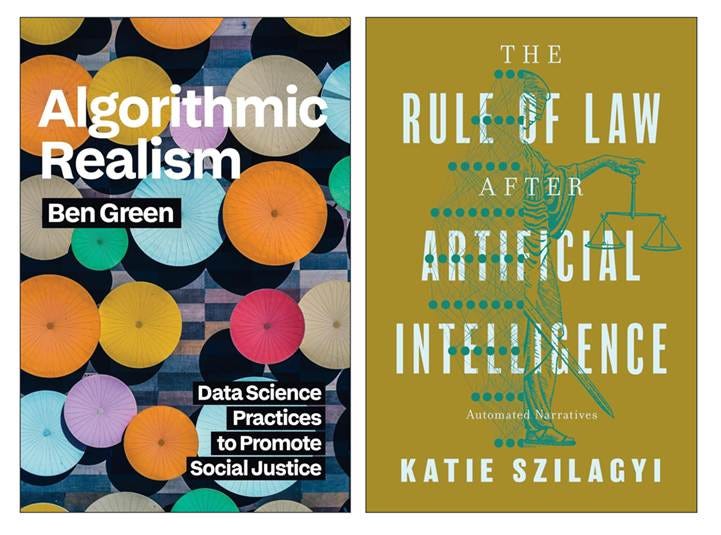
BEN GREEN, ALGORITHMIC REALISM: DATA SCIENCE PRACTICES TO PROMOTE SOCIAL JUSTICE (2026)
Book Description:
The field of data science faces a moral crisis. Despite the desires of data scientists to develop algorithms for good, algorithms regularly produce injustice in practice. Given these persistent harms, the field must reflect on difficult questions about its identity and future. Can data science be a force for promoting social justice in the world? What practices should data scientists follow to achieve this goal?
In Algorithmic Realism, Ben Green presents a bold and interdisciplinary approach to data science. Drawing on his experience practicing data science in the public interest, he argues that improving society with algorithms requires transforming data science from a formalist methodology focused on mathematical models into a practical methodology focused on addressing real-world problems. By providing an expanded framework for the “data science workflow”—the steps that characterize the algorithm development process—he offers a practical, step-by-step guide describing how data scientists can apply their skills in service of social justice. Through these contributions, the book reveals a vision for a renewed, but realistic, optimism about data science’s potential to foster a more equitable world.
KATIE SZILAGYI, THE RULE OF LAW AFTER ARTIFICIAL INTELLIGENCE: AUTOMATED NARRATIVES (2026)
Book Description:
Artificial intelligence is proliferating in many professions, and the legal field is no exception. In The Rule of Law After Artificial Intelligence, Katie Szilagyi investigates the philosophical and practical implications of using AI in legal spaces, beginning with several fundamental questions: What is the law supposed to do, and from where does it derive its authority? Would law still achieve these aims if automated? How might automation affect the rule of law’s integrity and democratic institutions’ operations?
Blending legal philosophy, applied case studies, and insights from both critical legal scholarship and science and technology studies, Szilagyi argues that law and storytelling are deeply connected. Through creating and contesting the law, we make sense of the information around us and generate narratives about our collective world. These narratives are not static: legal precedent evolves, and legal deliberation on hard cases can help to resolve unclear or unprecedented social issues.
Szilagyi demonstrates that technological innovations make the rule of law vulnerable because large language models and machine learning undermine the visioning function of legal narratives, collapsing exercises of legal interpretation into mere administration. Datafication of law—built on the biased data of our cultural past—threatens longstanding legal ideals, lessens the constraints against abuses of power by private actors, and hamstrings society’s ability to reach a more egalitarian future. Szilagyi argues instead for centering narratives within the law and, in turn, rediscovering the tales the law tells us about who we are.
For earlier editions of Works Worth Your Attention, see here.