

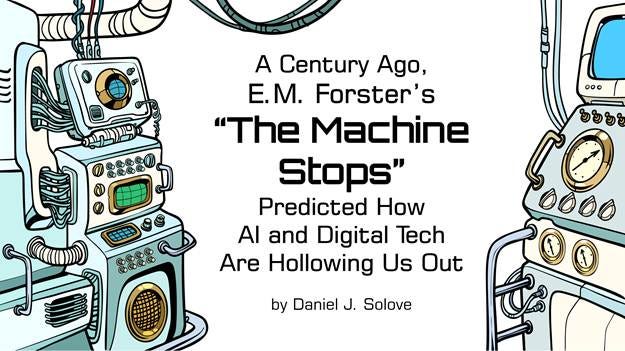
“We created the Machine, to do our will, but we cannot make it do our will now.” These lines are from E.M. Forster’s prescient story, “The Machine Stops” from 1909. Dystopian fiction has long warned us about the future, and we’re witnessing dire warnings from last century come true today. Forster’s story captures many of the current problems with AI and digital technologies.
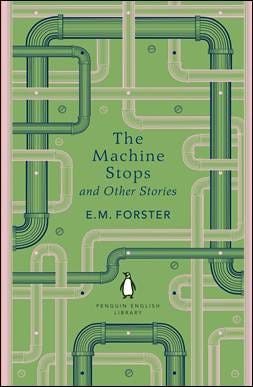
The story takes place in a dystopian future where the environment on Earth’s surface is so destroyed that it is unlivable. Humans live underground in an elaborate network of rooms. Each person is isolated in a separate hexagonal room. They communicate via TV screens. People’s physical needs are provided by the Machine.
The story focuses on two characters, Vashti and her son Kuno. They’ve never met each other physically until Vashti finally visits Kuno. Eventually, the Machine stops functioning, and calamitous consequences ensue.
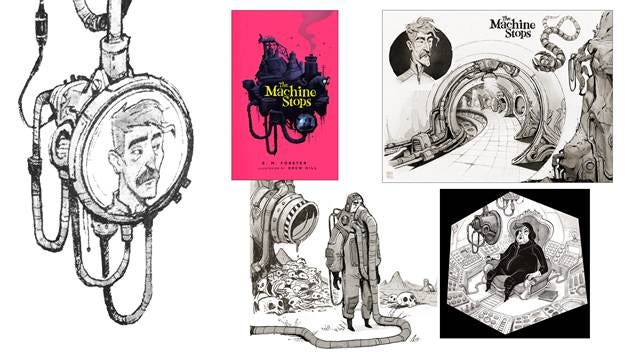
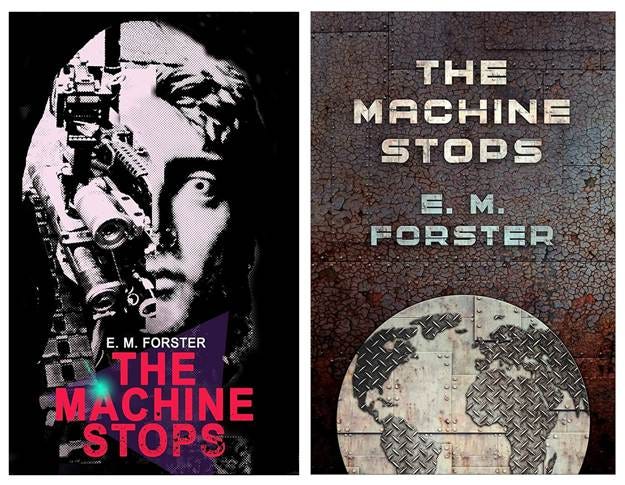
Drew Hill’s illustrated edition of “The Machine Stops”
Forster’s story eerily anticipates the internet and the isolation and dehumanization that is increasingly a part of modern life. People interact entirely through screens, like the way they interacted during the Covid pandemic on Zoom calls. Forster’s story frequently points out the thinness of interacting this way:
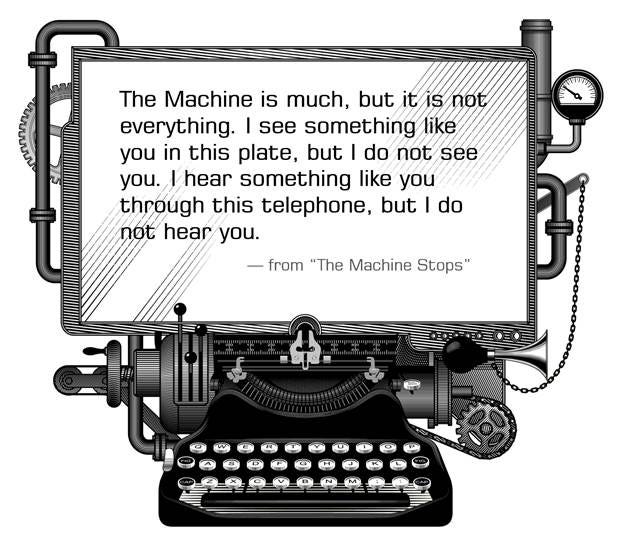
The Machine is much, but it is not everything. I see something like you in this plate, but I do not see you. I hear something like you through this telephone, but I do not hear you.
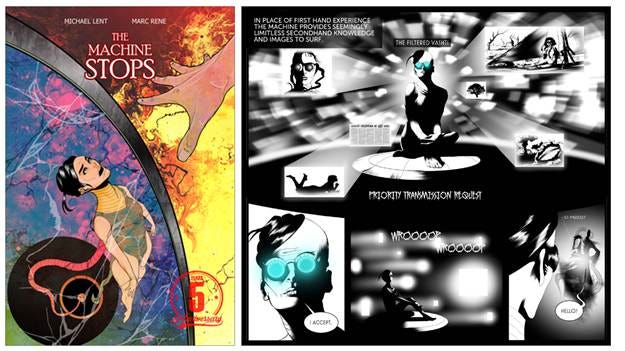
Michael Lent & Marc Rene, Global Comics edition of “The Machine Stops”
Another theme is the replacement of original things and experiences with simulations, summaries, and second-hand information:
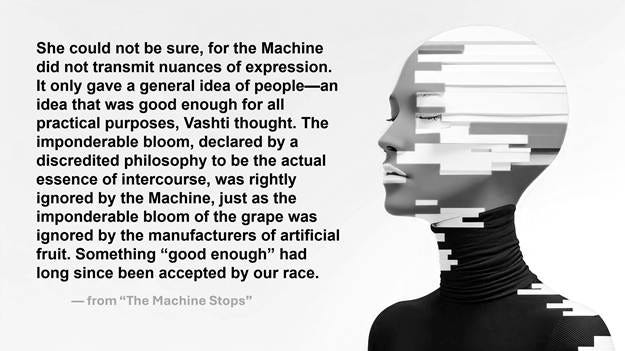
She could not be sure, for the Machine did not transmit nuances of expression. It only gave a general idea of people—an idea that was good enough for all practical purposes, Vashti thought. The imponderable bloom, declared by a discredited philosophy to be the actual essence of intercourse, was rightly ignored by the Machine, just as the imponderable bloom of the grape was ignored by the manufacturers of artificial fruit. Something “good enough” had long since been accepted by our race.
Today, we are often accepting “good enough” with AI. Its output vacillates between being adequate and being riddled with errors or hallucinations. Often, AI output reads smoothly on a skim, but when studied more carefully, its hollowness is revealed. Rarely is AI output transcendent or inspired.
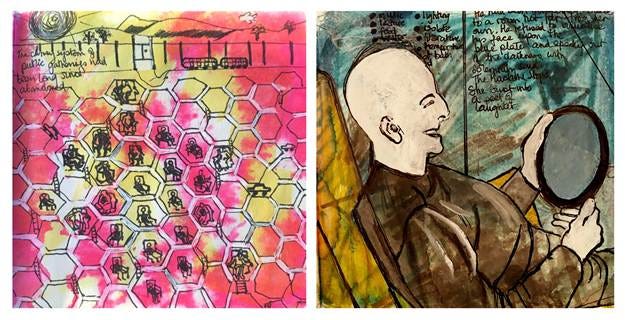
Illustrations by Susan Askew
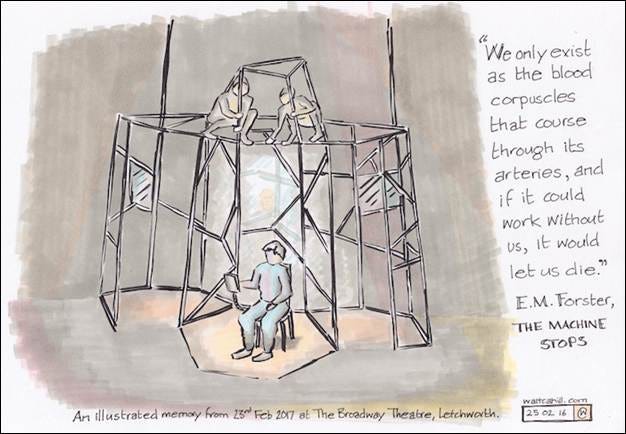
Illustration by Walt Cahill
The story also captures how AI is ruining the internet, transforming it from a place of first-hand discovery to a place of pre-masticated mush. First, I’ll quote from the story:
First-hand ideas do not really exist. They are but the physical impressions produced by love and fear, and on this gross foundation who could erect a philosophy? Let your ideas be second-hand, and if possible tenth-hand, for then they will be far removed from that disturbing element – direct observation. . . . There will come a generation that had got beyond facts, beyond impressions, a generation absolutely colorless, a generation ‘seraphically free from taint of personality,’ which will see the French Revolution not as it happened, nor as they would like it to have happened, but as it would have happened, had it taken places in the days of the Machine.
Google and other companies are aggressively pushing AI upon us, using it to summarize searches rather than provide us with search results. Google is planning to diminish regular search results even more in the zeal to promote its AI, whether we want it or not.
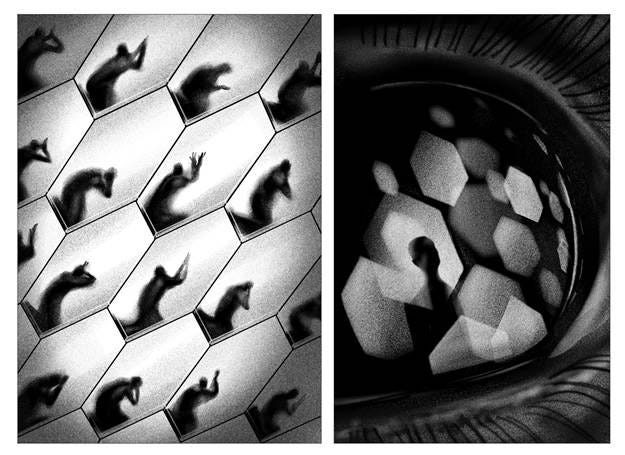
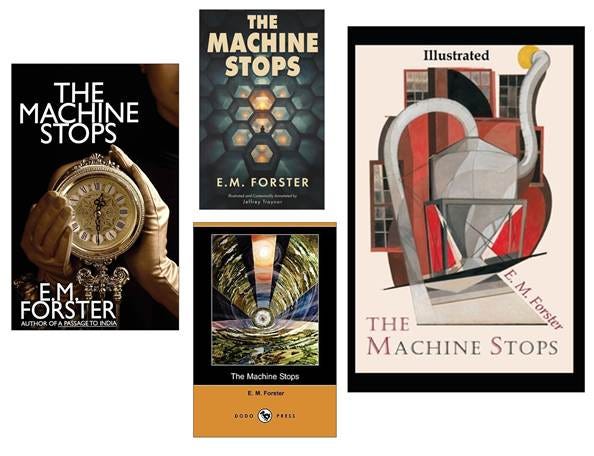
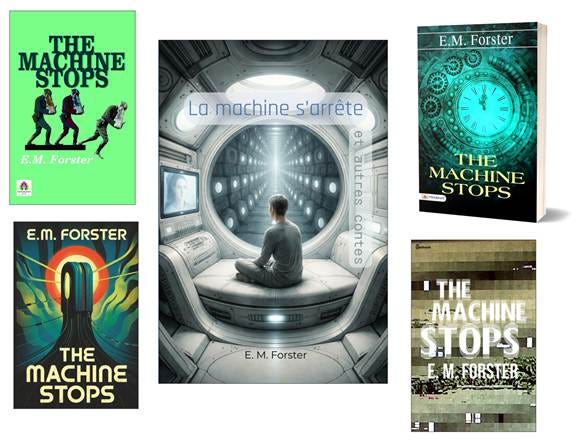
Illustrations by Daniel Stolle
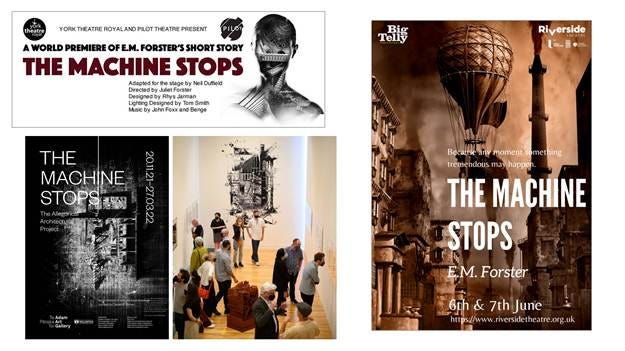
Adaptations and Art
Drew Magary in the SF Chronicle argues: “Google dot-com is less of a utility now than it is a roach motel: Enter something into its prompt, and suddenly you find yourself trapped inside a dungeon with no way out.”
He continues:
I naively assumed that Google, for all of its amorality, still found tremendous financial value in the sharing of information, of using the internet’s unfathomable power to connect people with one another, and with one another’s work in turn. I didn’t expect it to become so rapacious, not to mention cynical, and that it would gleefully lead the tech sector’s charge to render human ideas, human beings, a depreciated asset.
For a content provider like me, this change is devastating. Instead of people going to my site for direct information, they are now getting an AI summary instead. Search is being transformed from a way to discover information to being fed stolen material ground up and reconstituted by AI—the intellectual equivalent of Gefilte fish . . . or, maybe something akin to pink slime.
Not only does AI give us soulless slop, but it kills off the vital living creators whose insights and work it consumed, digested, and excreted in the process. As Magary notes, “when Google’s algorithm de-prioritized external links, it killed off traffic to all publishing sites, this one included, by about a quarter or more virtually overnight.”
Forster’s story notes that the Machine originally was created to help people achieve their ends but turned into an end unto itself:
Cannot you see, cannot all you lecturers see, that it is we that are dying, and that down here the only thing that really lives is the Machine? We created the Machine, to do our will, but we cannot make it do our will now. It has robbed us of the sense of space and of the sense of touch, it has blurred every human relation and narrowed down love to a carnal act, it has paralyzed our bodies and our wills, and now it compels us to worship it. The Machine develops – but not on our lines. The machine proceeds – but not to our goal. We only exist as the blood corpuscles that course through its arteries, and if it could work without us, it would let us die.
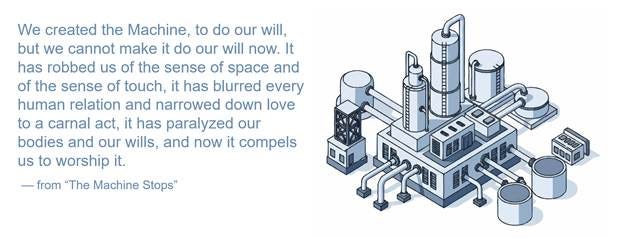
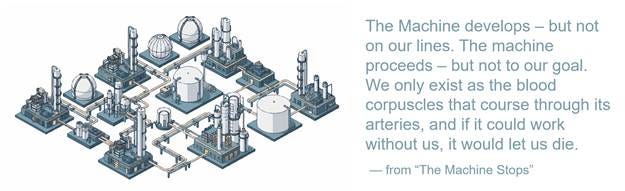
Currently, AI is ceasing to be a tool to help us and is becoming one to replace us. It is getting harder and harder to avoid AI being inserted into our lives, shoved like a screen between us and actual things and experiences.
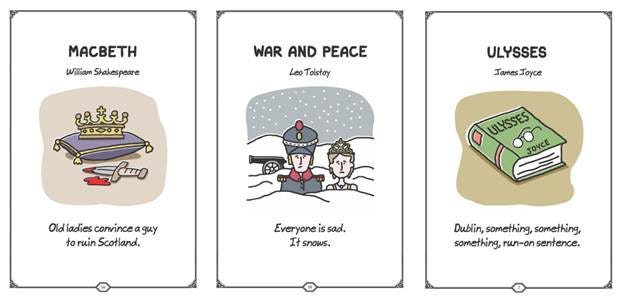
Instead of reading actual works, we are increasingly reading AI summaries. John Atkinson’s hilarious Abridged Classics captures what’s lost when we consume summarized works rather than the works themselves.
AI certainly has potential to do good, but unfortunately, it’s often on the opposite trajectory. As Woodrow Hartzog and Jessica Silbey write in their powerful article, How AI Destroys Institutions:
AI systems outsource moral choices to machines that should be made by humans, flatten the hierarchical structure that privileges persons over things, removing critical points of reflection and conflict. This, in turn, ossifies the ability of institutions to take intellectual risks in response to changing circumstances and prevents adaptation. Third, AI systems isolate people by displacing opportunities for human connection, interpersonal growth, and the cultivation of shared purpose. This isolation deprives institutions of the necessary solidarity and the space required for good faith debate and adaptability.
We’re well on our way to the dystopia in Forster’s “The Machine Stops.” It is remarkable how relevant this story is to the way AI is now being used to take over and replace everything.
* * * *
Professor Daniel J. Solove is a law professor at George Washington University Law School. Through his company, TeachPrivacy, he has created the largest library of computer-based privacy and data security training, with more than 180 courses.

Subscribe to Solove’s Free Substack
A supplement to Solove’s regular newsletter with more in-depth discussions