


Here’s a roundup of my privacy and AI scholarship in 2025.
ON PRIVACY AND TECHNOLOGY
Oxford University Press (2025)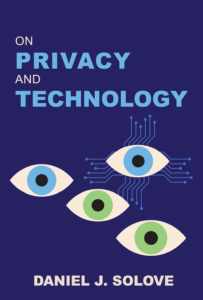
From the book jacket:
Succinct and eloquent, On Privacy and Technology is an essential primer on how to face the threats to privacy in today’s age of digital technologies and AI.
With the rapid rise of new digital technologies and artificial intelligence, is privacy dead? Can anything be done to save us from a dystopian world without privacy?
In this short and accessible book, internationally renowned privacy expert Daniel J. Solove draws from a range of fields, from law to philosophy to the humanities, to illustrate the profound changes technology is wreaking upon our privacy, why they matter, and what can be done about them. Solove provides incisive examinations of key concepts in the digital sphere, including control, manipulation, harm, automation, reputation, consent, prediction, inference, and many others.
Compelling and passionate, On Privacy and Technology teems with powerful insights that will transform the way you think about privacy and technology.
Quotes from On Privacy and Technology
Click here to see a few key quotations from the book.

FINAL PUBLISHED ARTICLES
The Great Scrape: The Clash Between Scraping and Privacy
113 California Law Review 1521 (2025) (with Woodrow Hartzog)
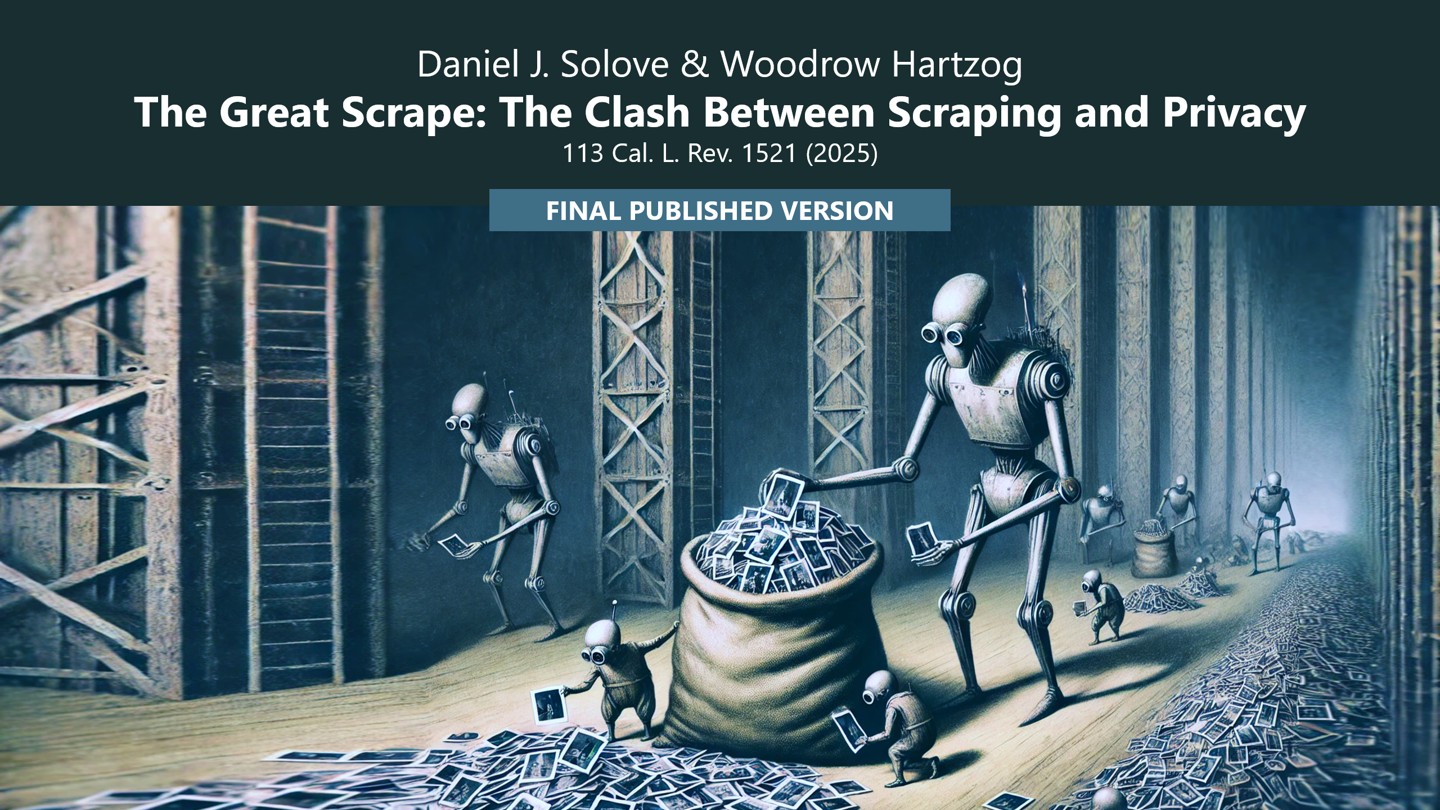
In this Article, we contend that scraping must undergo a serious reckoning with privacy law. Scraping violates nearly all of the key principles in privacy laws, including fairness; individual rights and control; transparency; consent; purpose specification and secondary use restrictions; data minimization; onward transfer; and data security. Scraping has evaded a reckoning with privacy law largely because scrapers act as if all publicly available data were free for the taking. But the public availability of scraped data shouldn’t give scrapers a free pass. Privacy law regularly protects publicly available data, and privacy principles are implicated even when personal data is accessible to others. This Article explores the fundamental tension between scraping and privacy law.
Artificial Intelligence and Privacy
77 Florida Law Review 1 (2025)

This Article aims to establish a foundational understanding of the intersection between artificial intelligence (AI) and privacy, outlining the current problems AI poses to privacy and suggesting potential directions for the law’s evolution in this area. Thus far, few commentators have explored the overall landscape of how AI and privacy interrelate. This Article seeks to map this territory. Overall, AI is not an unexpected upheaval for privacy; it is, in many ways, the future that has long been predicted. But AI glaringly exposes the longstanding shortcomings, infirmities, and wrong approaches of existing privacy laws. In this Article, I provide a roadmap to the key issues that the law must tackle and guidance about the approaches that can work and those that will fail.
The Prediction Society: AI and the Problems of Forecasting the Future
2025 Illinois Law Review 1 (2025) (with Hideyuki Matsumi)

In this paper we argue that the use of algorithmic predictions is a distinct issue warranting different treatment from other types of inference. We examine the issues laws must consider when addressing the problems of algorithmic predictions.
Notable Privacy Books: A Journey Through History
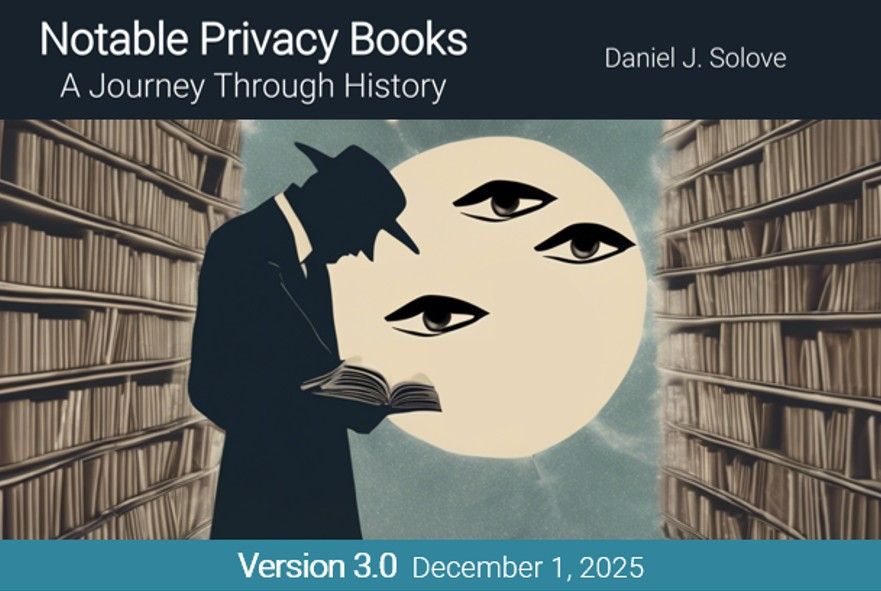
In this essay, I discuss notable privacy books from the 1960s to 2020s – seven decades and more than 500 books.
I briefly explain why each book is noteworthy. Examining the books chronologically also opens a window into history, as the books reflect the concerns, ideas, and terminology of the times in which they were written. The books also shed light on the discourse about privacy, which has evolved over the decades. In the past few decades, attention to privacy issues has significantly increased, and the number of books has proliferated. The books involve many perspectives, fields, and approaches: philosophical, journalistic, sociological, legal, literary, anthropological, political, empirical, psychological, and historical.

Professor Daniel J. Solove is a law professor at George Washington University Law School. Through his company, TeachPrivacy, he has created the largest library of computer-based privacy and data security training, with more than 180 courses.
Subscribe to Solove’s Free Substack
A supplement to Solove’s regular newsletter with more in-depth discussions